







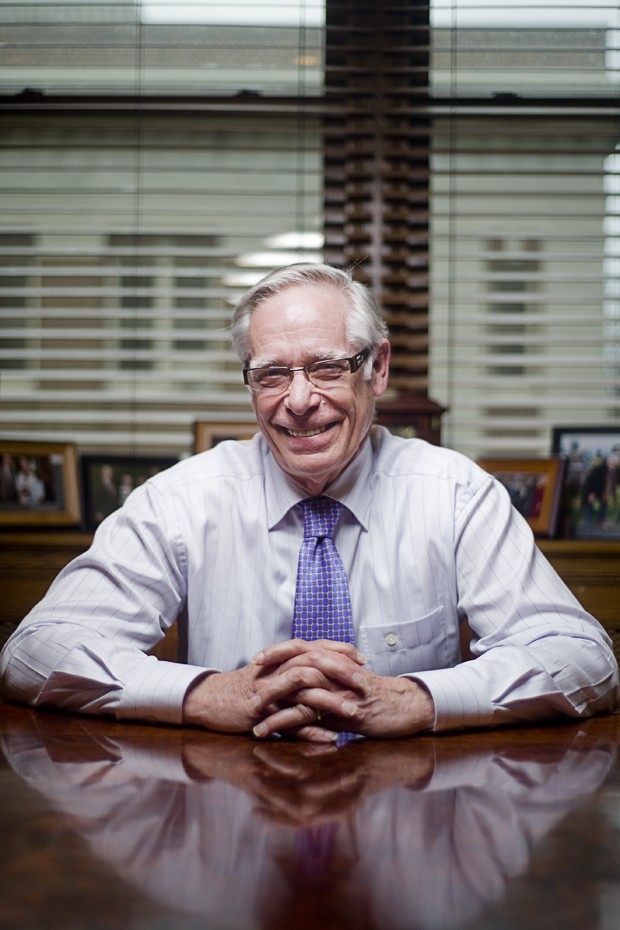
On Monday, the Minnesota Daily sat down with University of Minnesota President Bob Bruininks in his Morrill Hall office to discuss his plans for dealing with Gov. Tim PawlentyâÄôs March 17 budget, which includes replacing state money with federal stimulus money for the University. Then Bruininks answered questions about two bills the Legislature is debating concerning the power of the Board of Regents. One bill would give the Regents the power to make ordinances on University property, which could carry misdemeanor penalties . The other bill would forbid the University from serving alcohol in the premium seating areas of TCF Bank Stadium unless it was served in all areas and it would strip the Board of RegentsâÄô ability to allow alcohol sales at other campus venues. Currently, the board has decided there will only be alcohol sales in premium seating areas of the stadium. Bruininks also addressed the rumors that Coach Tubby Smith will be leaving Minnesota for another coaching job.
In the governorâÄôs updated budget, he plans to cut some of the UniversityâÄôs base appropriation and replace it with one-time federal money. How does the University plan to deal with this over the next four years?
What happens under the federal stimulus law is states can actually, in our case, reduce our budget [by] $110 million a year. And that gets replaced with federal stimulus money that is basically one-time money. Now the problem for the University of Minnesota is that [itâÄôs] not a good way to fund continuing costs âÄîthat is costs for salaries and fringe benefits, and debt and operating expenses on buildings. But this money is enormously important to the University for a number of reasons. It will allow us to maintain high levels of employment here at the University, and to take some of the reductions that are necessary to balance the budget two years from now more through attrition than through layoffs. But in two years weâÄôre going to face the inevitability of needing to solve this budget problem. It will be solved in a couple of ways. We need to increase our budget, our ongoing revenues from non-state sources, so thatâÄôs tuition, thatâÄôs private gifts, thatâÄôs grants and contracts, thatâÄôs other sales and services âÄî all of these activities that represent about 75 percent of the UniversityâÄôs budget. Second priority will be to reduce the UniversityâÄôs cost wherever we can reduce costs and lower the cost of operations here. In some cases, that will be âĦ reducing the number of people who work at the University of Minnesota âĦ Now all of us hope the economy will improve, tax receipts will improve in Minnesota, and that there will be some increase in the UniversityâÄôs budget in the year 2012 and 2013 âĦ but all of that depends on economic recovery that no one can see at the present time.
As part of increasing revenue, are students still looking at some kind of a tuition increase?
There will be a tuition increase for students, but that tuition increase will also be offset by some of the federal money. The tuition increase is absolutely necessary because we need to increase the UniversityâÄôs ongoing budget, its recurring resources that pay the ongoing year by year costs of the University. It really is too early at this point to project what that level will be, but I can promise you that whatever the level is, there will be a strategy to buy down the impact on students and families.
Considering all the uproar, are you still planning to recommend that the Regents Scholarship be cut by 25 percent at the May regents meeting?
IâÄôm not sure this recommendation will be actually recommended at the May meeting. WeâÄôre getting a lot of advice from employees and members of the University community that I find to be very helpful and very constructive. We will ask for some modest contribution from employees to cover the cost of tuition. I think thatâÄôs fair. WeâÄôre raising the cost of education for students at all levels of the University of Minnesota, and I think itâÄôs reasonable to ask the same kind of commitment from our employees. But I am also mindful of the fact that this program was started to help lower income employees pursue the dream of a university education at the University of Minnesota and to pursue that education to complete their first college degree. The other point that I think has been mostly lost in this discussion is that major changes in federal legislation, namely an increase in the federal tax credit and the opportunity for increased tax deductions allow people to recover these costs. So the net impact on employees from making this modest co-pay is going to be relatively small and largely made up by changes in the federal tax law.
There are a couple bills that are at the state Legislature right now that IâÄôd like to ask about. Does the Board of Regents need the ordinance power thatâÄôs suggested in Rep. NelsonâÄôs bill? TheyâÄôve never had it before, and weâÄôve had stadiums on campus before.
[The people planning the stadium] feel that the opportunity to create these ordinances would allow us to manage game-day activities much more safely and more effectively. WeâÄôre discussing these issues with members of the state Legislature, consulting with the city of Minneapolis, about the concerns and issues that they have raised, and IâÄôm hopeful that together we can come up with some pretty good solutions. But you are talking about bringing in tens of thousands of people in a very short period of time, along with people who are visiting the campus for other reasons so this could be âÄî on game day you could have 75,000 new people on campus in a short period of time in a fairly compressed area of the University campus. But IâÄôm hopeful that whatever the issues are can get resolved âÄî I frankly donâÄôt see this as a major issue at the present time.
ThereâÄôs another bill that would require the University to either not sell any alcohol in the new stadium or to sell it throughout.
IâÄôm quite aware of this legislation and have talked to the major authors about it. Again, we felt that we were best served by following the example of about 95-plus percent of the Division I programs around the country. I fully recognize that there are differences of opinion on this particular issue. I think in such matters you try to learn from the experience of others and we tried to model our policies after the best practices that are used in campuses all across the United States, including all of them in the Big Ten.
Speaking of Big Ten sports, thereâÄôs been a lot of talk lately, I know Tubby says that heâÄôs not leaving, but are you getting tired of the rumors [that heâÄôs leaving]?
In the world of collegiate sports the rumors tend to fly around more frequently and more loudly. I think Coach Smith and his wife and family are really happy in Minnesota, and I think this is a great job for him and I think he really has enjoyed his experience in coaching the Minnesota Gophers. IâÄôve had the opportunity to talk with him personally, to congratulate him on his year. And IâÄôm quite convinced heâÄôll stay as our head basketball coach.
