





Education is a big part of the mission work done by the School Sisters of Notre Dame , so when then-University of Minnesota neurologist David Snowden approached the sisters in 1986 about entering into a research project that involved the donation of their brains posthumously, they seriously considered it. âÄúOne of the wisdom figures stood up and said, âÄòweâÄôre not going to need our brains when weâÄôre deadâÄô,âÄù Catherine Bertrand, provincial leader of the Mankato province , said. âÄúThey saw themselves as being educators in life, and they would love to continue to be educators in death.âÄù The Nun Study, as itâÄôs called, has tracked the cognitive abilities and motor functions of more than 600 nuns over the past two decades and continues to study the donated brains as theyâÄôve passed on. The brains have been processed and placed in plastic containers, and sit shelved outside neuropathologist Dr. Karen SantaCruzâÄôs office. Since only about 50 of the nuns are still alive, the University now houses about 600 brains. Although a majority of the work was done at the University of Kentucky after Snowden took a position there, the University of Minnesota regained possession of the Nun Study when he announced his retirement last year. âÄúThis is where the study started when Dr. Snowden was at the University of Minnesota,âÄù said Harry Orr, professor and director of the Institute for Translational Neuroscience. âÄúAnd one of the larger convents of the sisters is located in Mankato.âÄù The nuns make for a very unique population to study, he said, because of their similar lifestyles. âÄúThey donâÄôt smoke, they donâÄôt drink, so you can reduce the effects of some of these other environmental factors,âÄù Orr said, âÄúand focus in on other factors that might be harder to get your hands around in other population studies.âÄù Orr said the University also proposed taking the Nun Study in a very interdisciplinary direction going forward, incorporating investigators from a range of fields: education, imaging, neuroscience. Among the studyâÄôs findings are a relationship between early childhood education and reducing the susceptibility to AlzheimerâÄôs disease, he said. They also found a relationship between traumas to the brain, such as strokes, and an increased susceptibility to AlzheimerâÄôs. âÄúWe are thrilled,âÄù said Michelle Barclay , vice president of programs for the AlzheimerâÄôs Association Minnesota-North Dakota . âÄúIt gives us information about how people can age successfully, what we might be able to do to prevent or slow down AlzheimerâÄôs disease.âÄù The AlzheimerâÄôs Association will host âÄúThe Meeting of the MindsâÄù regional conference this weekend, where Dr. Kelvin Lim , the studyâÄôs scientific director, will present the study to the Midwest AlzheimerâÄôs community, she said. Another interesting finding has been that some of the nuns brains look like they have AlzheimerâÄôs, Barclay said, but the women werenâÄôt exhibiting symptoms before they died. âÄúIf thatâÄôs the case, there may be things you can do, even though you have the disease to slow down or prevent the expression of the disease symptoms,âÄù Barclay said. Major advances in AlzheimerâÄôs research since the Nun Study began mean researchers now know what dementia looks like in the brain. SantaCruzâÄôs job involves studying slices of the brains, searching for patterns, such as the ones where the pathology indicated brain dementia but the annual cognitive tests showed otherwise. The researchers then work to connect the dots to establish the relationships, comparing the brain data with the cognitive and motor skills tests from when the nuns were alive, and also information about their lives before the convent. Since the materials arrived at the University, the administrative team under Orr has set up a budget for the next two years and started developing a framework for a second nun study. Orr said they hope to enroll a second group of nuns and use strengths within the University, such as advanced magnetic resonance imaging and genetics, to continue studying the nuns. âÄî Emma L. Carew is a senior staff reporter.


Nun brains assist in dementia research
U researchers hope brains of more than 600 nuns hold info about Alzheimer’s.
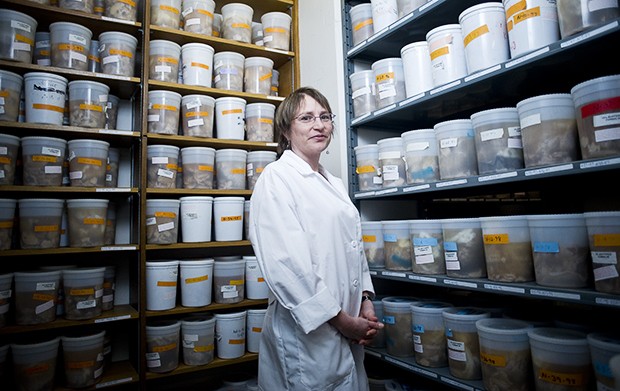
Image by Jules Ameel
Assistant Professor of Neuropathology Karen Santa Cruz stands in front of more than 600 brains in Diehl Hall.
Published March 25, 2009
