

Formidable Flat WHERE: First Amendment Gallery, 1101 Stinson Blvd. N.E. WHEN: Until Tues., June 23 âÄúFormidable Flat,âÄù an exhibit created by printmakers Kristina Paabus and Drew Peterson, takes on a tricky subject: the illusion of space. While that may seem hard to represent visually, the two artists use their skills at layering complex patterns and color arrangements to explore the relationship between 2-D and 3-D to find out just how complex the idea of âÄúflatâÄù can be. Paabus and Peterson met two years ago when working on a mural for the Nomad World Pub. âÄúWe just met and went to town on the wall,âÄù Peterson explains. They agreed on the title and focus of the exhibit because their printmaking was so grounded in the second dimension. âÄúWe were thinking about developing form and space in an ambiguous sense,âÄù Peterson explains. âÄúTaking a flatness that wasnâÄôt big or wasnâÄôt a bullying flatness wasnâÄôt aggressive or mean, as in, that definition of formidable. It wasnâÄôt negative, but awesome.âÄù Set in the twice-removed basement site of the First Amendment Gallery, the exhibit is like walking through a maroon, industrial door into a vaguely Dr. Seuss -inspired world of color. The first thing a visitor will see is âÄúRoaming Fact,âÄù PaabusâÄô ambitious piece of installation art that wraps itself behind the door like an explosion of yellow clouds and green slices of light. It looks like the end of Dr. SeussâÄô âÄúThe Lorax,âÄù where the magic fabric extracted from the truffula trees exposes the darker side of human nature. PaabusâÄô favorite aspect of the piece is that it seems to crawl behind the door, as if it is going to continue in the bathroom, but instead it simply ends. âÄúNo possibility exists there,âÄù she explains. PaabusâÄô 2-D pieces share similar imagery that pits natural images against the abstract, sitting closely enough on the vertex to let associations drift into both realms. She explains that her interest in printmaking began in her childhood home, where she was surrounded by print-heavy Estonian art. A first-generation American, Paabus used art to get back to her roots, studying in Estonia before settling down at The School of the Art Institute in Chicago. Growing up bilingual, Paabus also uses printmaking to explore the idea of syntax and combinatorial play in language. Her print pieces for âÄúFormidable FlatâÄù were all made with the same set of 50 hand-drawn stencils. Like letters in the alphabet, she explains, âÄúOn their own they donâÄôt mean anything, but when put together they create hierarchies. Language is a concrete thing we understand, but itâÄôs constantly changing and growing.âÄù For Drew Peterson, layering stencils is also a way to explore the passage of time. Many of his prints share a motif of technological doo-dads, many of them combined to create super fan-bike-computer hybrids. Peterson explains that he is interested in âÄô20s advertisements that feature isolated objects that represent âÄúnew inventions that were making people feel better when they were sitting in their own houses.âÄù Many of the pieces look similar, but what separates one from the other is the particular blend of bold colors, making them, as a set, fairly abstract. Peterson agrees that his use of color resembles that of abstract artists, explaining that he consciously thinks about âÄúinitiating an emotional response using color.âÄù Lined up against one wall of the gallery, a set of prints resembles a rainbow spectrum that starts in the cool-toned middle and carries on into warmer colors. PaabusâÄô and PetersonâÄôs styles are just similar enough to complement one another. While PetersonâÄôs prints have fine, painstaking detail and PaabusâÄô remain abstract, they both represent a bold, super-saturated exit from the minimalism that dominates todayâÄôs current Apple -driven design aesthetic.

Formidable Flat makes a case for 2D
Local artists Kristina Paabus and Drew Peterson get philosophical about their latest exhibit
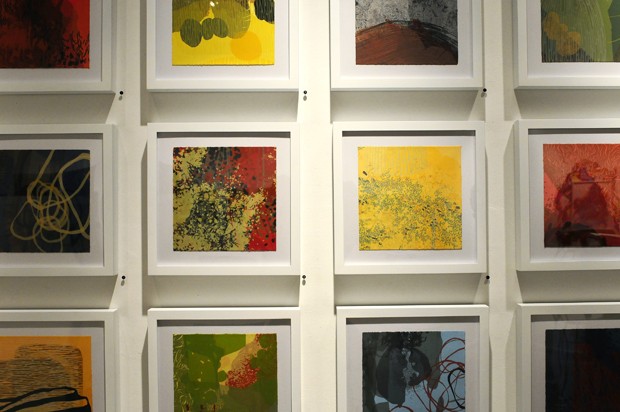
Image by Ashley Goetz
Published June 9, 2009
More to Discover