




Editor’s note: The last name of the main subject of this story, Ashref, and his family members has been removed from this story since its original publication. The source became concerned of the negative implications that may come from speaking critically of the Tunisian government and its programs upon his return to his home country. Ashref wants to be a leader of his country. And with his bold statements, straightforward views and ambitious visions, this TunisianâÄôs statement is not unrealistic. A 23-year-old student of English and American literature and civilization, Ashref was chosen to partake in the U.S. Department of StateâÄô s Study of the U.S. Institute (SUSI) for Student Leaders. He is one of 20 undergraduate students from North African nations at the University of Minnesota to take part in the SUSI program, which concludes with a conference in Washington, D.C. The students depart Wednesday. Study of the U.S. Institutes The students, who hail from Algeria , Egypt , Libya , Morocco and Tunisia , applied for the program through the U.S. Department of StateâÄôs Bureau of Educational and Cultural Affairs. Students participated in a series of classes and field trips that educated them on the U.S. government as well as providing a sample of American culture, with a Minnesotan twist. The Washington, D.C . based Academy for Educational Development supplied a model for the seven U.S. universities that are hosting international students for the program. The academy is a nonprofit organization that works globally for societal improvement. Sandra MacDonald, vice president and director of the AED leadership and institutional development group, said one of the goals of SUSI is to offset unfavorable perceptions the exchange students may have gotten of the U.S. from the media. âÄúI hope they [the students] gain a balanced perspective of the United States people, culture [and] our values, so that they have some real life experience with which to compare what they see on television and in the movies,âÄù MacDonald said. A family of academics Ashref was born in the small town of Sers, Tunisia into a family of academics. He currently lives with his family in the Tunisian capital Tunis while attending school there. Ashref’s sister, Siwar, has had similar experiences to those Ashref has had with SUSI. Siwar, 24, participated in an Arab womenâÄôs leadership conference, and Ashref partially credits his international opportunity to her, as Siwar helped in filling out AshrefâÄôs SUSI application. One generation back, education still reigns. AshrefâÄôs mother, Hadhria , is an Arabic teacher at a Tunisian equivalent of a U.S. high school. Ashref’s father, Abdelhafidh , was a revolutionary leader in his time, and Ashref seems to be a natural leader as well. Ashref seemed hesitant to share information about his fatherâÄôs perhaps controversial political involvement, but did not decline to show his respect for the man, who currently teaches French in Tunis. âÄúI am proud of my father,âÄù he said. Leadership in the blood AbdelhafidhâÄôs past in standing up to the Tunisian government and its influence on his son is obvious when Ashref speaks of his countryâÄôs politics. Ashref said he senses bitterness in TunisiansâÄô opinions of their government. âÄúWe need only to feel somebody fighting for the people,âÄù he said. Ashrefi showed pointed disgust at the Tunisian education system in particular. Although free of charge, the colleges show their stinginess through poor conditions. Ashref said classrooms are simple âÄî a desk, a chair, a pen âÄî and oftentimes operate without air conditioning. âÄúSometimes you do not find a place to sit,âÄù Ashref said. Ashref was supportive of the Tunisian governmentâÄôs plans to decentralize Tunisian universities, as he said there are too many based out of the capital Tunis, resulting in overcrowding of the city. âÄúStudents are really struggling in the capital because of financial means âÄî you have the right to be in a dorm one year, sometimes two,âÄù he said. âÄúBut then you have to rent a house to carry on your studies âĦ you imagine that a father who has two sons at university, it would suck.âÄù College as a Muslim Compared to the plethora of opportunities the Twin Cities offers, Ashref said students in Tunisia enjoy playing cards, as there are few other choices. âÄúGenerally students are not active,âÄù he added. Perhaps the largest disparity between college culture at the University and that of Tunis is the average social scene. While a night out at an American university might entail drugs, alcohol and sex, Ashref said his countryâÄôs religion, Islam, weakens the popularity of what many might label as sinister rites of passage at U.S. colleges. This is not to say young Tunisians live without passion: for many, soccer is life. âÄú[Karl] Marx said âÄòreligion is the opium of the masses ,âÄô âÄù he said. âÄúIn Tunisia, soccer is the opium of the masses.âÄù But what might appear as the glue which holds a fragile nation together may actually be driving it apart. Ashref said the different soccer leagues and their respective fan bases have actually intensified hatred between Tunisian regions. âÄúYou can hate somebody only because he belongs to a [certain] region,âÄù he said. Culture shock The Washington, D.C. conference, the last part of the studentsâÄô stay in the U.S., will unite the North African students at the University with six other groups of students that are also in the United States for the same program. At the conference, each group of students will present on their home countries, as well as on what they have learned at their exchange universities. âÄúEverything we say is really taken seriously,âÄù Ashref said of his studies in Minnesota. The SUSI program entailed a combination of University classes and Minnesota culture for the North Africa students. The students have visited the state Capitol , Fort Snelling , Lake Calhoun and Duluth, whereas the classes focus on more serious aspects of the United States, such as its politics, policies and people. Jodi Sandfort, an associate professor at the UniversityâÄôs Humphrey Institute of Public Affairs , taught a July 7 session about U.S. and international nonprofits. âÄúIâÄôm hoping to give [the students] both a sense of the potential of what citizens can accomplish when they come together to solve problems, and some very concrete models of how you manage and lead organizations that are about that goal,âÄù Sandfort said. Ashref also stayed with a gay Jewish family for a weekend while in Minnesota. While their beliefs differed, Ashref said this family was as welcoming as the rest of the people he has met in Minnesota, and that he and the family accepted each otherâÄôs beliefs. âÄúI found that people here are friendly,âÄù Ashref said of his new regard for the U.S. âÄúThe question is,âÄù he asked, âÄúare all people in America like this, or only Minnesota?âÄù A hope deficiency Ashref has a vision for his country, and a vision for his life. But what bothers him, he said, is how so few young people around him at home have similar dreams. âÄúThey do not have hope,âÄù he said of his peers, some of whom he said simply study mechanically in order to obtain a degree. Ashref had a fairly philosophical view on his education. âÄúIâÄôm just studying to learn,âÄù he said. âÄúTo build personality.âÄù Ashref seems to see a mentor, or at least inspiration, in President Barack Obama, who is popular in northern Africa. âÄúHe has what is lacking in Tunisia, which is hope,âÄù Ashref said. He joked about what his friends asked of him before he came to the U.S.: âÄúIf you see Obama, say hi to him.âÄù


Tunisian visitor shares philosophies, views of the U.S.
Ashref, a student from Tunisia, visited the U with a group of North African students.
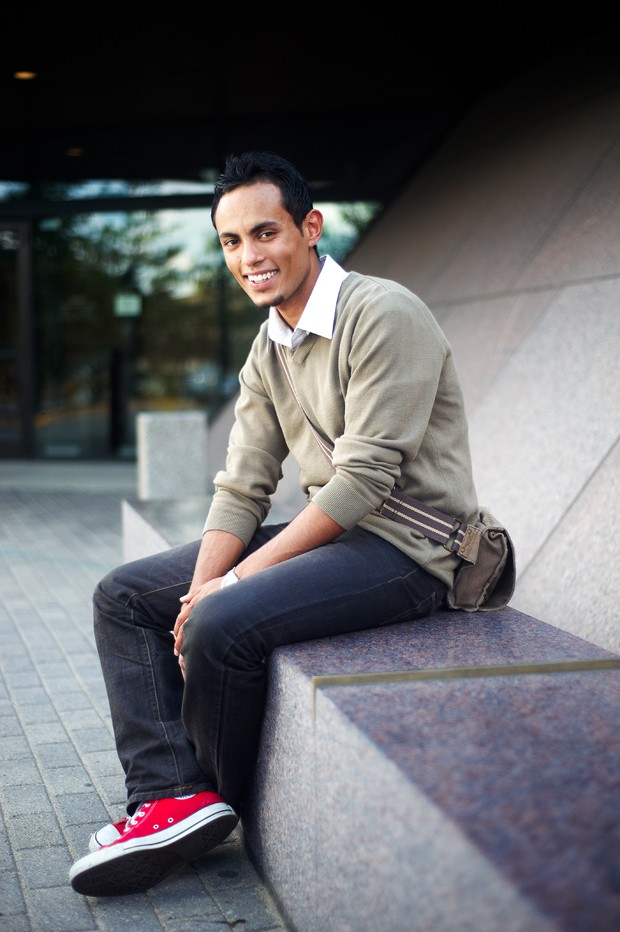
Image by Jules Ameel
Tunisian English literature student Ashref, 23, has been a part of a group of 20 North African students who are getting a realistic perception of America. The students in the program hail from Algeria, Egypt, Libya, Morocco, and Tunisia have been living in Minnesota for the last month.
Published July 28, 2009
