





In 2008, infants in China began exhibiting mysterious kidney problems. That fall, news broke that several companies had added melamine, a dangerous industrial chemical, to milk to boost its apparent protein content. By the end of the year, six children had died, and nearly 300,000 fell ill. The World Health Organization called on researchers to develop a rapid test for melamine. As it turned out, an enzyme able to detect the substance had been sitting in Larry WackettâÄôs lab at the University of Minnesota for years. Wackett and the University sold the enzyme to Bioo Scientific Corp., a solution Wackett called âÄúwin-winâÄù for a technology previously of no use to the general public. The idea to commercialize research breakthroughs from American universities is hardly new; quite the opposite, itâÄôs been statutorily mandated for 30 years. But as state appropriations stagnate or decline and federal research budgets are stretched to their limit, alternative sources of revenue have become increasingly critical for public institutions. Royalties from patents, profits from startup companies and fees from licenses can be plowed back into both research and student support. Meanwhile, those startups and licenses are put in the hands of companies to distribute the technology beyond a universityâÄôs reach. The University of Minnesota Office for Technology CommercializationâÄôs revenues have nearly doubled in the past six years, from $48.4 million in 2004 to $95.2 million in 2009. While acknowledging the difficulties inherent to commercialization, many researchers believe collaboration between industry and academia is necessary if research is to achieve its most basic goal: improving lives. âÄúWhat still persists on many campuses is the idea that interaction with business or companies is contradictory to academic integrity,âÄù Tim Mulcahy, University vice president for Research, said. âÄúThat is not the case.âÄù Funding and finding the âÄònext big thingâÄô The American Recovery and Reinvestment Act of 2009, commonly referred to as the stimulus bill, appropriated $21.5 billion for scientific research, equipment and science-related construction projects. Funds were distributed to usual suspects like the National Institutes of Health and the National Science Foundation, as well as organizations such as the Advanced Research Projects Agency-Energy. ARPA-E, a subset of the U.S. Department of Energy, received $400 million from the stimulus in April 2009. It is modeled after the Defense Advanced Research Projects Agency, a U.S. Department of Defense organization responsible for, among other things, the Internet. Instead of focusing on incremental improvements, ARPA-EâÄôs mission is to fund potentially transformational advancements in energy technology, the ultimate goal being reduced dependence on foreign energy. ItâÄôs a high-risk, high-reward program, and chances are, its success wonâÄôt be measurable for five to 10 years. But if just one proposal produces marketable results, it will revolutionize how the United States makes energy, Wackett said. In late October, after reviewing more than 3,000 proposals, ARPA-E made its first wave of 37 grants totaling $151 million. Among them was a $2.2 million project spearheaded by Wackett that aims to use immobilized bacteria to activate the production of liquid hydrocarbon fuels. In conjunction with University spinoff BioCee, which has the technology to stimulate reactions using microorganisms, Wackett hopes to create biopetroleum using sunlight, water and carbon dioxide. He describes the mechanism as a thin film similar to latex paint. âÄúThink of a film like that, but now itâÄôs 50 percent bacteria, which are catalyzing some kind of reaction,âÄù Wackett said. This reaction produces the same petroleum found in pipelines and refineries across the world. Of course, $2 million isnâÄôt enough to scale up the technology if it works. For that, industry must take over, and thatâÄôs the idea, Wackett said. âÄú[ARPA-E] is saying, âÄòOur goal is to get that first step, and if you guys are successful, then companies will be coming left and right.âÄô âÄù James Carey hopes thatâÄôs true. In October, the physical therapy program professor and researcher was awarded a two-year stimulus grant by the NIH to study a treatment for pediatric strokes. The device sends painless magnetic stimuli through a childâÄôs skull to repeatedly activate neurons in the brain. The hope, Carey said, is to âÄúwake upâÄù dormant neurons after the stroke so ultimately they will activate on their own. CareyâÄôs research has always been federally funded, which he prefers. A researcher that works with industry must take extra precautions, he said, and federal grants like those from NIH carry more weight and credibility. But Carey realizes federal funds are limited, and if his current project is successful, it may take corporate money to spur widespread use of the device. âÄúIt takes so long to get something like this approved and recognized as a valid tool that I donâÄôt think federal funds would be able to carry it the distance,âÄù he said. The bigger question, however, isnâÄôt who will commercialize that âÄúnext big thingâÄù; rather, itâÄôs who will discover it. According to Mulcahy, University vice president for research, itâÄôs becoming more likely that the answer will be a university researcher. Willard Boyle and George Smith, 2009 Nobel Laureates in physics, did their award-winning work in the 1960s at AT&TâÄôs iconic Bell Labs. Though Bell Labs still exists as Alcatel-Lucent Bell Labs, todayâÄôs industrial labs are a shadow of what they once were. Companies must answer to investors who demand short-term returns. In many instances, doing âÄúbasic researchâÄù âÄî a misleading phrase that describes research focused on breakthrough discoveries âÄî is no longer economically feasible. The lag time between cost and an uncertain benefit is too risky and too long. As a result, researchers said, universities house an ever-higher percentage of the basic research being done in America, and connections to industry are becoming ever-more important. âÄúIt is important that [the university-industry] relationship be fostered and grown,âÄù Roberto Peccei, UCLA vice chancellor of research, said, âÄúreally for the good of the country.âÄù The growing branch of commercialization The University Office of Technology Commercialization is an intriguing entity. It is affiliated with the University yet entirely self-sustaining. To survive, its revenues must cover its operating expenses. Any additional income is injected back into departmental research, scholarships and fellowships for graduate students and Innovation Grants, which support inventions that need a final boost to become licensable. Done correctly, technology transfer can be a powerful boost to a universityâÄôs research goals. The University has recently improved its processes and personnel, but royalties on the patent for Ziagen, an AIDS-combating drug manufactured by GlaxoSmithKline, accounted for over 90 percent of the OTCâÄôs revenues in fiscal year 2009. The multimillion-dollar royalties for that patent did not come easily. Illustrating the complex relationship between universities and big business, the University of Minnesota had to sue the pharmaceutical company, which at the time was called Glaxo Wellcome PLC, to win back the royalties. The pharmaceutical company argued that it did not use the UniversityâÄôs patented discoveries to develop the drug, but the University eventually settled the suit and earned the royalties in 1999. The OTCâÄôs vitality will soon depend on its ability to market other technologies. Finding those sources begins now, said Jay Schrankler, executive director of the OTC. Prior to joining the University OTC as executive director in April 2007, Schrankler spent 26 years at technology and manufacturing giant Honeywell Inc. For five of those years, he was a vice president on the automation and control side and ran the intellectual property licensing and marketing business, an arm he built from scratch. Hiring Schrankler was the first step in a plan âÄî spurred by Mulcahy âÄî to overhaul the OTC. Schrankler immediately set to the task of designing the office to run more like a business and infusing it with upgraded and experienced talent. The OTC is now in phase two of a three-phase plan to create a prosperous technology transfer enterprise. On Friday, Schrankler and Mulcahy presented the Minnesota Board of Regents with an update on the OTCâÄôs policy and process transformation. By most measures, the OTC is making progress. Despite licensing fewer technologies every year since 2004, revenues have steadily increased. ItâÄôs a sign that, on average, each new agreement is becoming more beneficial to the University. Navigating the processes and protocols required to move a technology beyond the lab, however, can be a maddening exercise for businesses and universities alike. âÄúThe fact of the matter is this: Licensing of intellectual property is complicated,âÄù Schrankler said, âÄúwhether you decide to license technology from a Fortune 50 company or a university.âÄù The gorilla in the room, for now, is Ziagen, without which 2009 revenues would have been $8.7 million instead of $95.2 million for the OTC. And the OTC canâÄôt wait until the patent on the drug expires to replace at least some of that revenue, Schrankler said. âÄúThis stuff takes time in the marketplace. The important thing to focus on now is the non-Ziagen revenue.âÄù So the OTC uses tools like express and fast-track licenses to simplify and expedite the complex process of technology transfer. Express licenses, Schrankler said, work just like buying software online with a credit card. Fast track licenses, conversely, allow companies to test drive the discovery before fully committing to it. Concurrently, the staff in SchranklerâÄôs office has a wealth of experience in private industry. âÄúThatâÄôs a key factor,âÄù he said, âÄúbecause you know what itâÄôs like on the other side. You know what itâÄôs like to sit in industryâÄôs shoes; you understand their problems.âÄù Of course, all of this serves to further blur the lines between corporate and academic America, a notion that Mulcahy said still makes some people uneasy. Most attention is focused on individual conflicts of interest, but conflicts can also exist at an institutional level. âÄúAs long as weâÄôre aware of it, itâÄôs a good thing,âÄù Mulcahy said. âÄúIf we ignore the tension, weâÄôre going to find ourselves in trouble.âÄù âÄòTranslationalâÄô research TodayâÄôs focus on commercialization derives its origins from a piece of legislation penned nearly 30 years ago. On Dec. 12, 1980, Congress passed the Bayh-Dole Act allowing universities and small businesses to retain intellectual property control of inventions arising from federally funded research. In return, the institution must strive to commercialize worthy discoveries, share royalties with the researcher and use any remaining income on education or research. Lynne Chronister, assistant vice provost for research and director of sponsored programs at the University of Washington, calls it âÄútranslational research.âÄù That is, taking âÄúthe results of research off the library shelf and pushing it into the economy.âÄù And if it hasnâÄôt been a focus of the federal government since the passage of Bayh-Dole, Mulcahy said, it certainly is now. Congress is under pressure to demonstrate a return on federal funds, so Congress pressures the NIH and NSF, which in turn pressure researchers to demonstrate quality of life improvements and opportunities for commercialization stemming from their work, Mulcahy said. âÄúThereâÄôs greater accountability at the national level, and it trickles down to all of us.âÄù Nevertheless, for many, the relationship between industry and academia seems unnatural; the entities have fundamentally different missions. But approached correctly, researchers agree the relationship is not only mutually beneficial, it is a universityâÄôs responsibility. Research, at its core, is for the benefit of society. It seeks truths that can improve peopleâÄôs lives. But it is neither a universityâÄôs goal nor its competency to market and manufacture research breakthroughs. Ultimately, the private sector is vital in proliferating the benefits of a discovery. Of course, there is universal agreement that the process should be approached with caution. Long before Wackett became a McKnight professor in biochemistry and a member of the BioTechnology Institute, he worked with 3M, one of his first collaborations with corporate America. When he completed his research, Wackett wanted to publish the results. 3M wanted the information to remain proprietary and file a patent. Ultimately, he wrote the paper, but that was WackettâÄôs introduction to the different objectives of researchers and businesses. Since then, he said, heâÄôs careful to establish an early understanding about the treatment of intellectual property. Like Mulcahy, Wackett used the word âÄútensionâÄù to describe the relationship between nonprofit universities and for-profit companies. âÄúThere is that tension whenever you have the university and industry working together,âÄù Wackett said. âÄúThere can be problems, but the best thing is having agreements up front.âÄù University physics professor and director of undergraduate research Marvin Marshak has never taken a dime from private industry. He studies neutrinos âÄî tiny, electrically neutral particles that travel near the speed of light. Industry has no use for them, he said. Still, Marshak understands the importance of connections between a university and its surrounding economic ecosystem. The connections can be delicate, he said, but they are necessary. âÄúWe are symbiotic; to pretend weâÄôre not, I think, is just unrealistic.âÄù


Technology commercialization: from research to revenue
As other sources dry up, revenue from research commercialization is becoming increasingly important for American universities. Attracting that revenue, however, is a complex process.
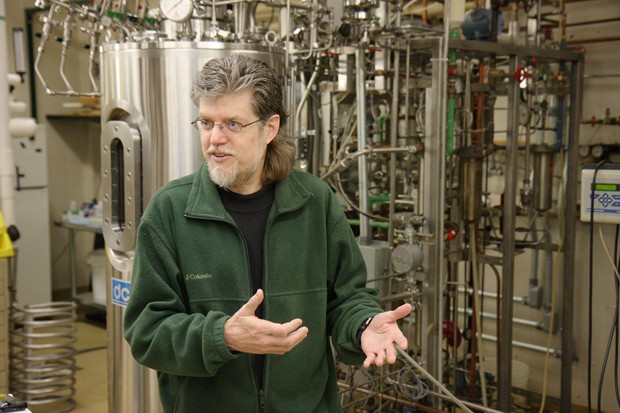
Image by Aleutian Calabay
McKnight professor Larry Wackett describes how these large drums were used to mass-produce the enzyme able to detect melamine in milk for use in Bioo Scientific’s MaxSignal rapid test kit in Minnesota’s BioTechnology Institute Pilot Plant.
Published February 16, 2010
