

While Lisa Ohman was preparing to start classes at the University of Minnesota College of Veterinary Medicine, HillâÄôs Pet Nutrition was sending her e-mails about being their campus representative. The third-year veterinary student now makes $9 an hour and gets free dog food to tell her peers about the companyâÄôs products. Ohman, who sees faculty members feeding HillâÄôs to their own pets, said sheâÄôll probably recommend it to her clients when she enters the practice. Such programs are not uncommon. The College of Veterinary Medicine received more than $5.4 million in the previous fiscal year from industry sponsors, including HillâÄôs, Purina, Royal Canin, Iams and Bil-Jac. The partnerships come in a variety of forms, including scholarships, program and event sponsorships, product seminars and luncheons and donated food, vaccines, medications and equipment. âÄúIf we didnâÄôt have those partnerships, that funding, we would have to cut some of the programming,âÄù Laura Molgaard, the collegeâÄôs associate dean for academic and student affairs, said. âÄúWe rely on them in order to provide some of the programming we give to our students.âÄù âÄòA different playing fieldâÄô Human and veterinary medicine are different animals, so itâÄôs no wonder they interact differently with the private sector, some experts say. Trevor Ames, dean of the College of Veterinary Medicine, said government entities provide significant funding to medical schools. By contrast, the veterinary profession is largely owner-funded, as clients decide what they do with their animals. âÄúThereâÄôs not this issue of government funding health care for our animals,âÄù he said. ThereâÄôs simply a lot more money at stake when it comes to human medicine, said Marguerite Pappaioanou, executive director of the Association of American Veterinary Medical Colleges. âÄúTheyâÄôre on a whole different playing field,âÄù she said. âÄúBecause of the huge amount of money on the human side, it has attracted congressional attention. ItâÄôs very public and very visible.âÄù Veterinarians make an average of $89,450 a year, compared to the $165,000 physicians and surgeons make, according to 2008 data gathered by the U.S. Bureau of Labor Statistics. With decreasing state support, the school is increasingly reliant on companies to support its programming, Molgaard said. ThatâÄôs similar to whatâÄôs happening at the Iowa State University College of Veterinary Medicine. âÄúWe definitely depend on our sponsors,âÄù said Bianca Zaffarano, a clinician in the collegeâÄôs Veterinary Medical Center. Veterinarians can still choose which products they use, unlike in human medicine where doctors are sometimes bound to prescribing the drugs of their corporate sponsors, Zaffarano said. âÄúWe arenâÄôt their handmaidens,âÄù she said. âÄúThereâÄôs still freedom in veterinary medicine to do the right thing for the animals, no matter where the product comes from.âÄù Contact with the companies teaches students to be critical of marketing, a skill thatâÄôs vital when they get into the practice, Molgaard said. âÄúThey need to learn how to make those decisions based on information as students so that later they can make them without blindly following the marketing of those companies,âÄù she said. âÄúWe want them to be informed consumers and informed providers.âÄù ItâÄôd be difficult for a company to provide false or misleading information about their product, as the faculty analyzes claims and looks into possible side effects, Ames said. âÄúThereâÄôs a creed in medicine of âÄòdo no harm,âÄô âÄù he said. âÄúYou always want to make sure you know as much as possible about the products youâÄôre using.âÄù Change on the horizon Early in his career, veterinarian and small animal cardiologist Paul D. Pion discovered commercial pet food âÄî primarily HillâÄôs âÄî was causing a deadly heart disease in cats. âÄúIt was thought to be the best food of the day,âÄù he said. âÄúPeople were shocked.âÄù His discovery, published in the August 1987 issue of Science, taught Pion to look deeper into the information companies provide. âÄúItâÄôs what you donâÄôt know thatâÄôs more dangerous than what you know,âÄù he said. Now, the president and co-founder of the Veterinary Information Network âÄî which stopped accepting corporate sponsorship over five years ago âÄî said itâÄôs impossible for people, however well-intentioned, to separate their ties to industries that support them when they make decisions. He said he would rather see veterinary schools cut their programs than take money from industries to support them. âÄúTheyâÄôre hard-up for money, and theyâÄôre bending their ethics,âÄù he said. The sea change thatâÄôs been happening in human medicine is slowly gaining steam in veterinary medicine, Pappaioanou said. âÄúWeâÄôre not too far behind in terms of getting good ethnical guidelines together,âÄù she said. More and more veterinary colleges are starting to look at their industry sponsors with a critical eye and are developing conflict of interest policies, she said. âÄúTheyâÄôre taking it very seriously,âÄù she said. The AAVMC is working on a conflict of interest policy. Although they have no control over what colleges choose to do, the policy will apply to their own company sponsorships. ItâÄôs too early to know how or whether the upcoming University-wide conflict of interest policy will affect the veterinary college when itâÄôs released, Ames said. While itâÄôs understandable that people worry about corporate influence in the veterinary school, the important thing is to teach students to mange relationships and avoid conflicts of interest, Molgaard said. âÄúThose conflicts will be available for them their whole careers,âÄù she said. âÄúWe canâÄôt shelter them here and then throw them out into the real world and expect them to know how to make appropriate, evidence-based decisions.âÄù
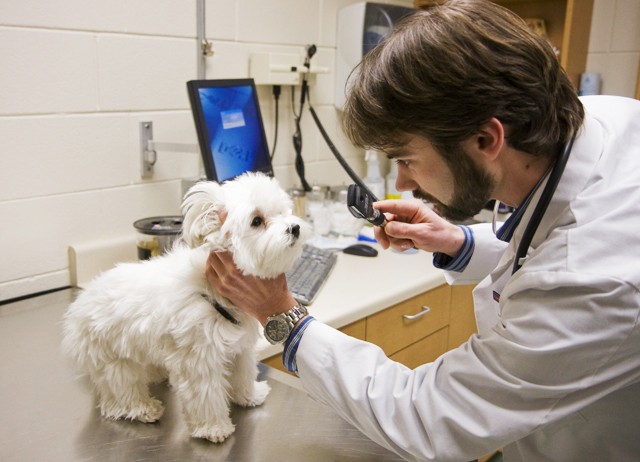
Image by Aleutian Calabay
Senior veterinary medicine major Jonathan Hart examines a dog named Bo at the University of Minnesota Small Animal Clinic on Wednesday. The College of Veterinary Medicine receives millions of dollars each year from industry sponsors such as Purina.
Vet School relies on external funding
Hill’s Pet Nutrition is a source of funding for one U veterinary student.
Published February 18, 2010