





With more than four decades to show for it, Ronald Phillips redefines the meaning of school spirit. Phillips, a RegentsâÄô professor of agronomy at the University of Minnesota, is retiring after the spring semester. âÄúMost people just ask why I just donâÄôt keep going,âÄù said the 70-year-old Phillips, sporting his maroon striped shirt accompanied with an embroidered University logo. Over the course of his storied career, Phillips has been widely celebrated for his myriad contributions to agriculture and plant genetics, specifically in his discovery of regenerating corn from cells. From 1996 to 1998, Phillips was the chief scientist for the U.S. Department of Agriculture and was a chairman on a White House committee responsible for drafting a congressional proposal for the National Plant Genome Initiative. He is also a recipient of the international Wolf Prize award that included prize money Phillips donated to the University. Early career While some students struggle with career plans in college, Phillips said he had it figured out as early as high school. âÄúI actually decided as a freshman in high school I wanted to go into plant genetics,âÄù Phillips said. Phillips attributes his early interest in plants and agriculture to his upbringing. Growing up in Crawfordsville, Ind., PhillipsâÄô father worked with hybrid plants, moderating meetings between farmers and dealers. As a child, Phillips accompanied his father to the meetings. After high school, Phillips attended Purdue University, majoring in crop science. It was there Phillips met genetics professor Wayne Keim, who, according to Phillips, âÄútook [him] under his wing.âÄù After being invited by Charles Burnham, a former University professor and plant genetics pioneer, Phillips continued his studies at the University of Minnesota, receiving a doctoral degree in genetics in 1966. Phillips said his early experience working with high-profile individuals drove him to delve deeper into the field. âÄúThere was a lot of depth. In fact, I wondered if I could ever understand it when I started,âÄù Phillips said. âÄúIt was like standing on the shoulders of giants.âÄù Awards, major findings and contributions Phillips is often highlighted for his groundbreaking discovery that led to the development of genetically engineered corn crops. During his postdoctoral study at Cornell University, Phillips worked with Ed Green âÄî now a world-renowned plant scientist âÄîon developing a technique that would utilize cells from which corn could be regenerated. âÄúGenetically engineered corn starts with these cells,âÄù Phillips said. âÄúDNA is put into it, and then plants are regenerated and a seed is obtained from those plants.âÄù While the technique is touted as a remarkable achievement for agriculture, over the years various environmental groups and government officials have opposed genetically modified food, expressing concern for health and environmental hazards. According to Phillips, genetically engineered crops account for nearly 2 billion acres of todayâÄôs agriculture production. The cropsâÄô advantages include higher levels of pest resistance and production rate. âÄú[The discovery] was the foundation for the genetic engineering of corn,âÄù said Howard Rines, a longtime colleague and University professor. âÄúIt was the key accomplishment that made that all possible,âÄù PhillipsâÄô work on the national level led Congress to pass the National Plant Genome Initiative. The initiative was launched in 1998 as a long-term project to accelerate advancement in plant biology through a coordinated approach by involving researchers and scientists from around the world. Its mission was to explore the DNA structure and function in plants so useful properties of plants could be understood, improved and ultimately harnessed to address national needs, including agriculture, nutrition, energy and waste reduction. In 2001, Phillips was awarded a $3 million grant from the initiative to research a radiation hybrid system for the genetic and physical mapping of the corn genome. Phillips conducted research over the course of four years. In 2007, Phillips received the international Wolf Prize in agriculture. The award recognized Phillips for his âÄúgroundbreaking discoveries in genetics and genomicsâÄù and included a $50,000 cash prize. Rines said he wasnâÄôt surprised when he heard about the award. âÄúHe is one of the well-known, outstanding leaders in agricultural sciences.âÄù Instead of keeping the money, Phillips had the organization make out the check to the University of Minnesota to help fund a new scholarship program called the Ron and Judy Phillips Plant Genetics Scholarship Fund, named after him and his wife. Post-retirement life As Phillips prepares to say farewell, he said heâÄôd like to stay involved with various projects, including his scholarship fund. He also said he hopes to continue a program he founded through his church that helps bring students from developing countries to study agriculture in the United States. Phillips has also been asked to sit on several advisory committees funded by the National Science Foundation. Looking back, Phillips said he believes a lot of his success had to do with the University and his colleagues. âÄúThis is a unique place. WeâÄôve got good facilities here to do this kind of work,âÄù Phillips. Joachim Messing, who is currently a molecular biology professor at Rutgers University, worked with Phillips while in Minnesota during the 1980s and continues to see Phillips regularly. âÄúRon was a great leader,âÄù Messing said. âÄúThe University will miss him a lot.âÄù



Prominent agronomy professor to retire at age 70
Ronald Phillips has been widely celebrated for his contributions to plant genetics and agriculture.
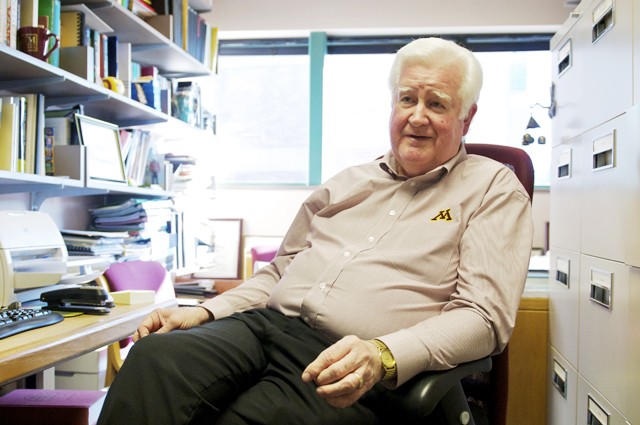
Image by Mark Vancleave
stphillips
Published March 4, 2010
