






Almost a quarter of the worldâÄôs population, or 1.5 billion people, are without electricity, according to a 2009 United Nations report, but a University of Minnesota student group is working to reduce that number. At the Institute of Technology, the group Innovative Engineers is developing and building wind turbines out of less expensive materials. The turbines will then be brought to underdeveloped countries, where Innovative Engineers will teach the population how to progress with the renewable energy. The mission of the group is to bring the turbines to countries that lack both electricity and the proper resources to develop it, according to Alejandro De la Mora, a civil engineering senior and president of the group. De la Mora said modern countries have the technology to develop sources for renewable energy, but the needs for this energy expand far beyond developed nations. âÄúIt is the entire planetâÄôs problem, not just First World countries,âÄù De la Mora said. This problem cannot be solved by simply giving these countries a wind turbine, according to De la Mora, who said the group also has a necessary role in teaching these countries how to develop and even improve the turbines on their own. âÄúOnce we show them how to build the turbines, we tell them to try improving them,âÄù De la Mora said. Sophomore mechanical engineering major Scott Morton said the biggest reason for the groupâÄôs formation lies in the ability to help these communities. âÄúI think members are very interested in building a wind turbine,âÄù Morton said. âÄúBut I donâÄôt think the whole project would have happened without a cause.âÄù Currently, the group is planning a trip to La Hermita, Nicaragua, where they will implement a 1-kilowatt wind turbine to a community that does not have electricity, according to De la Mora. Through a partnership with the National Society of Black Engineers, which also helped develop the turbine, students will bring the turbine to Nicaragua this summer. The group is working with the Universidad Nacional de Ingenieria âÄî a Nicaraguan university âÄî and Inatec âÄî a volunteering organization in Nicaragua âÄî to implement the turbine. Morton said getting to the point of having a turbine to introduce into a country, however, can be challenging. Morton said the group is responsible for finding the resources and funding necessary with little help from the University. âÄúThe University has a lot of equipment, but they have not made it very accessible,âÄù Morton said. Dr. Paul Imbertson, professor in the Department of Electrical and Computer Engineering and the groupâÄôs adviser, said these difficulties make it unique from most student groups. Imbertson said the majority of student groups have a project laid out for them with fixed funding, but he believes the way Innovative Engineers is set up provides them with exceptional experience. âÄúThey have to decide when to show up, what task they are going to do and how they are going to do it,âÄù Imbertson said. Morton said he hopes to make these questions easier to answer in the future. âÄúWith my project, I want to figure out exactly how to get things done around campus,âÄù Morton said. âÄúWith this, the next group that comes around will have a known way to do things.âÄù The next group that comes around is an area of focus for the Innovative Engineers. De la Mora said the group is going to start talking to introductory classes about the projects they are working on. âÄúWe want to make Innovative Engineers a group that stays,âÄù De la Mora said. âÄúWe want it to be on the top of IT groups.âÄù Morton said their recruiting does not stop with first-year college students. In fact, a high school will be touring the groupâÄôs facility Saturday. âÄúI think itâÄôs important to let people know that you can be a part of something when they come to this University,âÄù Morton said. âÄúWe are investing in the future of this club.âÄù Along with being the groupâÄôs adviser, Imbertson is also a large part of the groupâÄôs inspiration. Imbertson was the faculty member guiding some of the future groupâÄôs members while studying abroad in Scandinavia. The May-term global seminar course was focused on renewable energies, but some students walked away with more than added technical knowledge, Imbertson said. âÄúAfter the course, they were able to couple something they find terribly interesting with an understanding of how it can shape the future.âÄù For Morton, it was the motivation he needed. âÄú[Imbertson] added his philosophy of what is wrong and what needs to be changed,âÄù Morton said. âÄúFor me, that was it.âÄù The group, which was formed in August 2009, has the motivation they need, and now they are planning to build bigger than they ever have. Along with his fellow seniors in the group, De la Mora said they are developing a 10-kilowatt wind turbine with construction to begin next semester. The group asked for help from Fotis Sotiropoulos, professor in the Department of Civil Engineering, and the St. Anthony Falls Laboratory. Sotiropoulos, who is a director at the laboratory, said they had recently received a grant from the U.S. Department of Energy for $8 million. The grant required the laboratory to fulfill a curriculum aspect that could be assisted by partnering up with the student group. Sotiropoulos said he looks forward to working with the group. âÄúI saw their passion,âÄù Sotiropoulos said. âÄúThey are using their engineering talent to help people. That is what engineering is all about.âÄù



Innovative Engineers power Third World
The engineering student group is building wind turbines for underdeveloped countries.
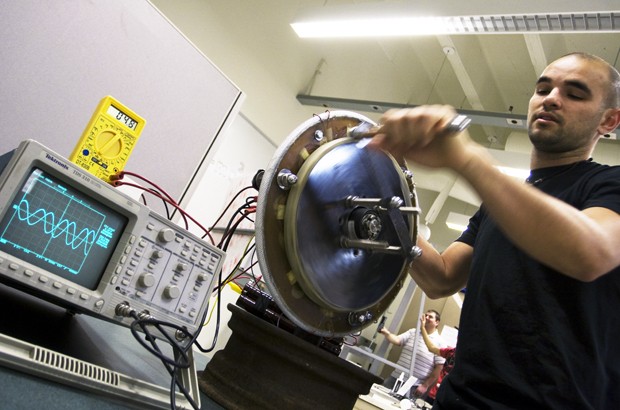
Image by Ian Larson
Innovative wind turbine
Published March 24, 2010
