3-D lab goes commercial

The lab, used to visualize complex data, needs to fill a funding gap.
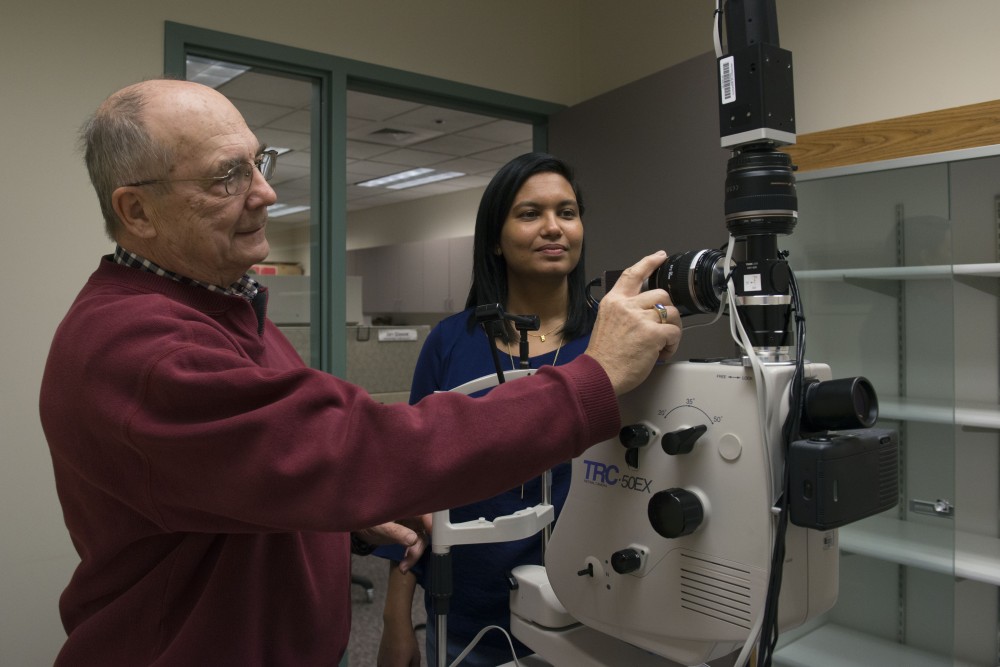
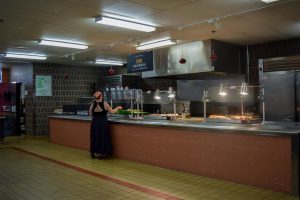
Director Nancy Rowe explains how the 3D glasses work with motion tracking to create a simulation that changes perspective when the viewer moves.
September 06, 2011

Three expansive monitors displayed a blurry multicolored image, but upon donning a pair of special goggles it transformed into an interactive human heart pulsing with simulated blood. An ultrasonic tracking system on the ceiling detected the user’s movements and shifted the image.
“This is virtual reality,” said Nancy Rowe, a consultant with the Minnesota Supercomputing Institute at the University of Minnesota.
The 3-D virtual reality laboratory in Walter Library visualizes complex data for the University’s researchers and students. But after recent funding cuts it’s now looking to lease the lab to commercial clients like medical researchers, physicists and businesses making medical devices to fill the gap.
MSI began promoting the lease last week, but has yet to secure any business, said Pratik Jagtap, a consultant at the institute.
The technology powering the laboratory could be used for “virtually anything,” Rowe said, and had been used to study laser fusion, medical research, astrophysics and even acoustics in ancient Greek buildings.
Jagtap said the laboratory was originally designed for the University’s researchers and their academic partners. Most of the equipment, worth roughly $500,000, was donated, Rowe said.
Jagtap said MSI is not leasing the laboratory for profit, but to fill gaps left after the University cut the institute’s funding.
Commercial clients would have no time or use limits for the laboratory, Jagtap said, and would probably rent it for a few hours a day.
He hopes to make “optimal use” of the facility by balancing business from commercial clients with the needs of the University researchers and classes using the equipment. The University researchers will get priority for the laboratory’s use, he said.
Astronomy professor Paul Woodward helped build the laboratory in 1995 with National Science Foundation research grants to visualize the massive calculations he worked with. He said although only a small group of researchers uses the laboratory, the facility’s importance should not be determined by how many people use it.
Similar commercial attempts at other laboratories resulted in “a lot of industrial secrecy” as clients restricted access to their research, Woodward said.
“We hope [the leasing is] done in a way that doesn’t conflict with open research,” he said.
Aside from research studies, Rowe said classes were often held at the laboratory during the school year, allowing students to delve more deeply into the subjects they were studying. Based on what he’s seen before,
Woodward is concerned that an increase in users may decrease access for researchers.
Assistant professor Dan Keefe, who used the lab to run heart simulations, said collaboration with private industry was valuable, and that the lab itself was a partnership between different institutes across the University.
But he said as some commercial clients would likely use the laboratory for private work, there should be a separate space for such projects. Right now, all simulations are kept to one room.

Minnesota Daily Serving the University of Minnesota Community since 1900