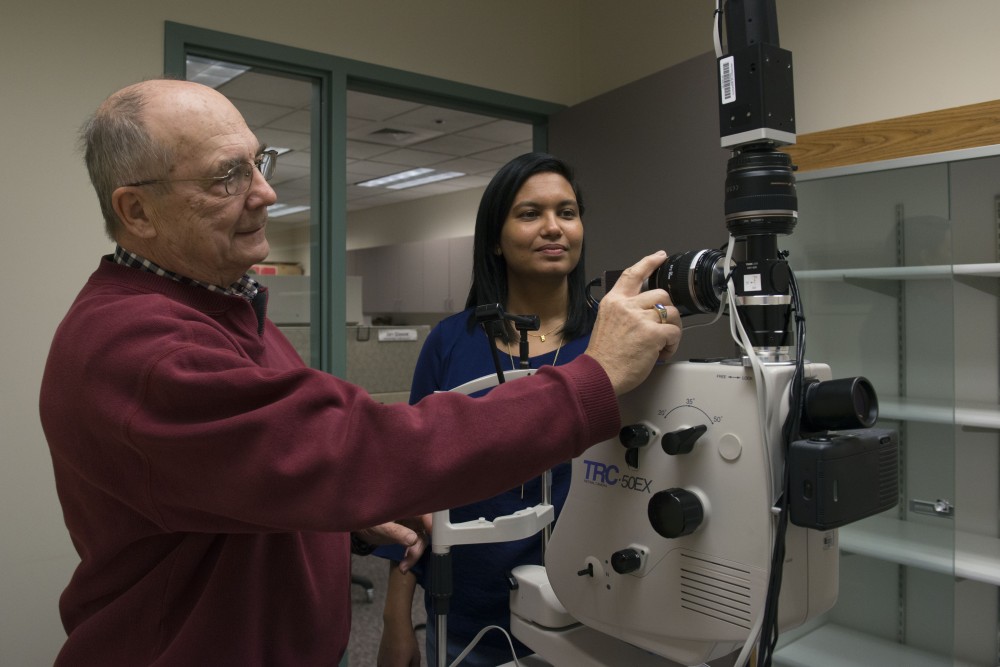
By using undergraduates for lab work rather than paying additional employees, professor Ann Rougvie saves money and has more help to further her research.
More than 200 undergraduate students in a course at the University of Minnesota’s College of Biological Sciences are doing some of the lab work, which ends up being mutually beneficial.
Students in the course, Foundations of Biology for Biological Science Majors, say they benefit from the experience of working in a real lab setting while Rougvie gets “lots of manpower” for her research, undergraduate research assistant Chris Tastad said.
“When you have 250 undergrads working on something, things can progress very quickly,” CBS Associate Dean Robin Wright said.
Because Rougvie’s research is incorporated into class work, CBS foots the bill for the necessary equipment.
The school uses the money that would have funded a “cookbook” lab — a normal University lab with strict direction and set outcomes — toward this “authentic” lab experience that benefits both students and faculty, Wright said.
Wright’s research was the first to be used when the course began five years ago. Even after that course ended, Wright took on 16 former Foundations of Biology students to work in her lab.
Those students got a glimpse into what a real scientific research environment is like.
“It is frustrating at times,” said sophomore Brandon Fryza, who is currently enrolled in the class. “But I like it because if you do want to work in a real research lab, it gives you a taste of it.”
After they finish the course, students have much more technical knowledge and confidence than their fellow undergraduates, Wright said.
But one of the current professors for the course said it can also be very challenging for students.
It’s the first exposure most students have to a realistic research environment, and it can be hard getting used to failure, said Catherine Kirkpatrick, who teaches the lab portion of the second semester of Foundations of Biology.
But, Wright said, “Most of research is failure.”
The course is designed to give students time to find an answer to the current research question, fail and then have enough time to repeat the experiment several more times.
“You plot your week around that experiment and that experiment fails,” sophomore Jason Giesler said. “You spend a decent amount of your life there,” he said.
Wright said other universities have looked to the course as a model for biology labs — she said it’s one of a kind in having more than 200 students work on real research within their coursework.
She’s been in conversation with universities around the U.S., Canada and most recently Egypt about how the course functions.
And it continues to change, Wright said.
Rougvie’s lab has been the class’s focus since last year, but there hasn’t yet been a breakthrough with her research on protein interaction.
“We’re optimistic that something will come out of it this year,” she said.
rom h�(lsH�gp�
Even if more students showed an interest in living near the St. Paul campus, they might struggle to find places to live.
The neighbors would probably need to be assured that students would maintain their clean and quiet lifestyles, without being too rowdy or noisy, said Wayne Groff, a realtor with Edina Realty in Roseville, Minn.
Groff agreed there is a market for student housing, but since most homes in the area are fairly expensive — $300,000 to $400,000 — most owners would not purchase them to rent them. He also said there isn’t much land in the area to make any new developments around campus.
Even the way people search for housing is different near the St. Paul campus, Groff said. The easiest way to find housing isn't to look on Craigslist — it’s to put your name and number on a bulletin board outside a coffee shop, or walk around and see what’s out there.
Read how Dr. William Lipham is at the forefront of new eye reconstructive surgery techniques in Minnesota.
If you have been involved in a car accident call a Philadelphia Car Accident Lawyer for a free consultation.

Comments (more »)